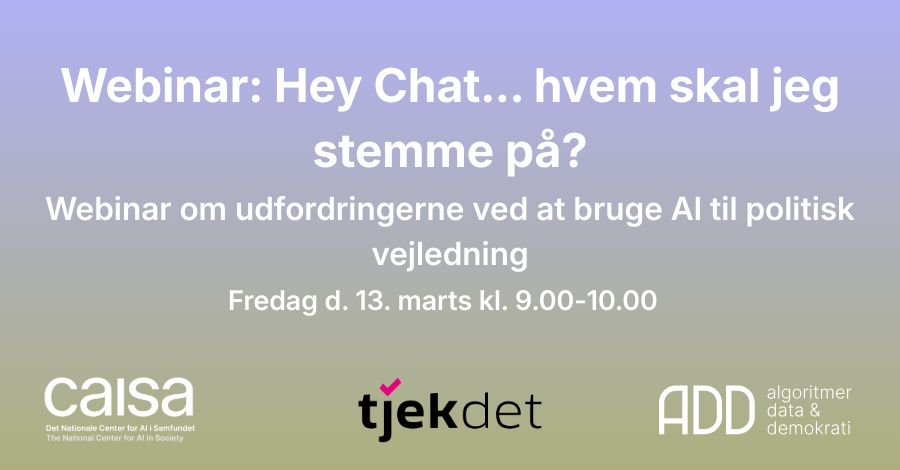
Hey Chat... Who should I vote for? (Translated)

The use of generative artificial intelligence is rapidly increasing, and today three out of four young people aged 16-24 use this technology - often in private contexts. This means that first-time voters, who may not yet have engaged deeply with politics, are increasingly turning to chatbots for guidance and advice. This development presents important opportunities, but also significant risks.
In the light of such trends, CAISA, TjekDet and the ADD project invite you to a professional webinar focusing on key questions at the intersection of AI, democracy, and youth engagement:
- How are young people affected when chatbots are used as political advisors?
- What biases, technical mechanisms, and algorithmic structures shape chatbot responses?
- What are the implications for democratic dialogue and young people's political formation?
The webinar brings together researchers and practitioners for a timely, research-based discussion of AI in elections and political communication. It is based on the educational material "Hey Chat... who should I vote for?" (Translated), developed by TjekDet for upper secondary education to strengthen young people's critical understanding of chatbots, misinformation, prompting, and source criticism in an election context.
Programme
09.00 AM – Welcome and introduction: Chatbots as a new source of political information during election campaigns.
09.05 AM – Introduction to the material: “Hey chat… Who should I vote for?” (Translated) and how it can be used to support critical AI literacy among students.
09.10 AM – AI and bias in language models
Stephanie Brandl, CAISA (presentation in English)
How do chatbots generate responses? Where does bias arise - and how do prompts influence outcomes?
09.25 AM – AI, democracy, and information sources
Thomas Ploug, Professor of AI Ethics, Aalborg University
What does it mean for democracy when AI becomes a source of political information?
09.35 AI – Discussion
Conversation between Thomas Ploug and Søren Engelbrecht, journalist at TjekDet
09.45 AM – Q&A
10.00 AM – Closing remarks
Other events
WEBINAR: Digital Suverænitet – få et fællessprog og forstå de afgørende domæner og kontrolregimer

Alle taler om digital suverænitet, men begrebet betyder vidt forskellige ting, alt efter om man sidder i et ministerium, en bestyrelse eller et forskningscenter. Og det er faktisk rimeligt nok, for digital suverænitet er forskellige ting. Men uden et fælles sprog risikerer vi at tale forbi hinanden, netop når beslutningerne haster:
Europas afhængighed af amerikansk cloud-infrastruktur vokser, AI kapløbet mellem Washington og Beijing accelererer, og Danmark skal navigere begge dele.
Digital suverænitet er komplekst – men hvad hvis vi fik et fælles sprog, så vi kan handle?
I dette webinar præsenterer Rebecca Adler-Nissen, Roman Jurowetzki, Morten Axel Pedersen og Kristin Eggeling et nyt forskningsbrief, der klæder dig på til at forstå:
Tre domæner, der kan afveje: sikkerhed, økonomi og rettigheder – og hvorfor de er gensidigt afhængige.
Tre kontrolregimer, der skal integreres or at lykkes: Ejerskab (af hardware, software, AI-modeller mv.), Videnskapacitet (organisatorisk, juridisk og STEM-kompetence) og Regulering (statslig, international eller fra magtfulde private aktører).
Hvorfor det kræver en treenighed – og hvad der sker, hvis ét element mangler (f.eks. ineffektiv regulering, dyr infrastruktur eller brain drain).
Efter præsentationen er der debat med Jan Damsgaard, professor og digital vismand og Rikke Frank Jørgensen, professor samt forskningschef ved Institut for Menneskerettigheder om, hvordan vi omsætter teorien til praksis.
Praktisk information
Format: Online webinar
Adgang: Link til webinaret tilsendes et par dage inden afholdelsen
Who Would ChatGPT Vote for and Why Should We Care?

A timely discussion in the wake of the Danish national elections.
Join us on April 16, 2026 for croissants, coffee, and a very timely and highly relevant one‑hour event examining how voters increasingly turn to AI chatbots for political guidance, and what this means for information quality, democratic participation, and digital critical thinking.
As tools such as ChatGPT, Claude, and Gemini rapidly enter the public information ecosystem, voters now navigate a landscape where AI-generated recommendations can influence perceptions of parties, policies, and political choices. This event brings together leading researchers and practitioners to discuss how AI-driven voting advice shapes public understanding and how societies can strengthen citizens' ability to evaluate such information critically.
Program & Speakers
Voting Advice in the Age of AI
Frederik Hjorth
Associate Professor at the Department of Political Science and the Center for Social Data Science, University of Copenhagen
Chatbots, First-Time Voters, and Digital Critical Thinking
Søren Engelbrecht
Journalist at TjekDet
Political Bias in Chatbots
Stephanie Brandl
Assistant Professor at the Center for Social Data Science, University of Copenhagen and Fellow at CAISA
The event concludes with a joint Q&A session, offering space for cross-cutting reflections and questions to all speakers.
Practical details
Date: April 16, 2026
Time: 9:00 - 10:00 a.m. (Doors open at 8:30 a.m. for coffee and croissants)
Location:
Blegdamsvej 3B, 2200 Copenhagen N. Room: Panum – Auditorium Victor Haderup